Why Every Business Website Must Be Agent-Ready in 2026: Preparing for the AI-Driven Internet
Visual Overview
For more than two decades, websites were designed primarily for humans and search engines. Businesses focused on user experience, mobile responsiveness, SEO, and conversion optimization.
Today, a new digital transformation is underway.
AI agents such as ChatGPT, Gemini, Claude, Perplexity, Microsoft Copilot, and other autonomous systems are increasingly interacting with websites on behalf of users. Instead of manually searching and browsing, people are beginning to ask AI assistants to find products, compare services, book appointments, complete purchases, and retrieve information automatically.
This shift introduces a new requirement:
Is your website Agent-Ready?
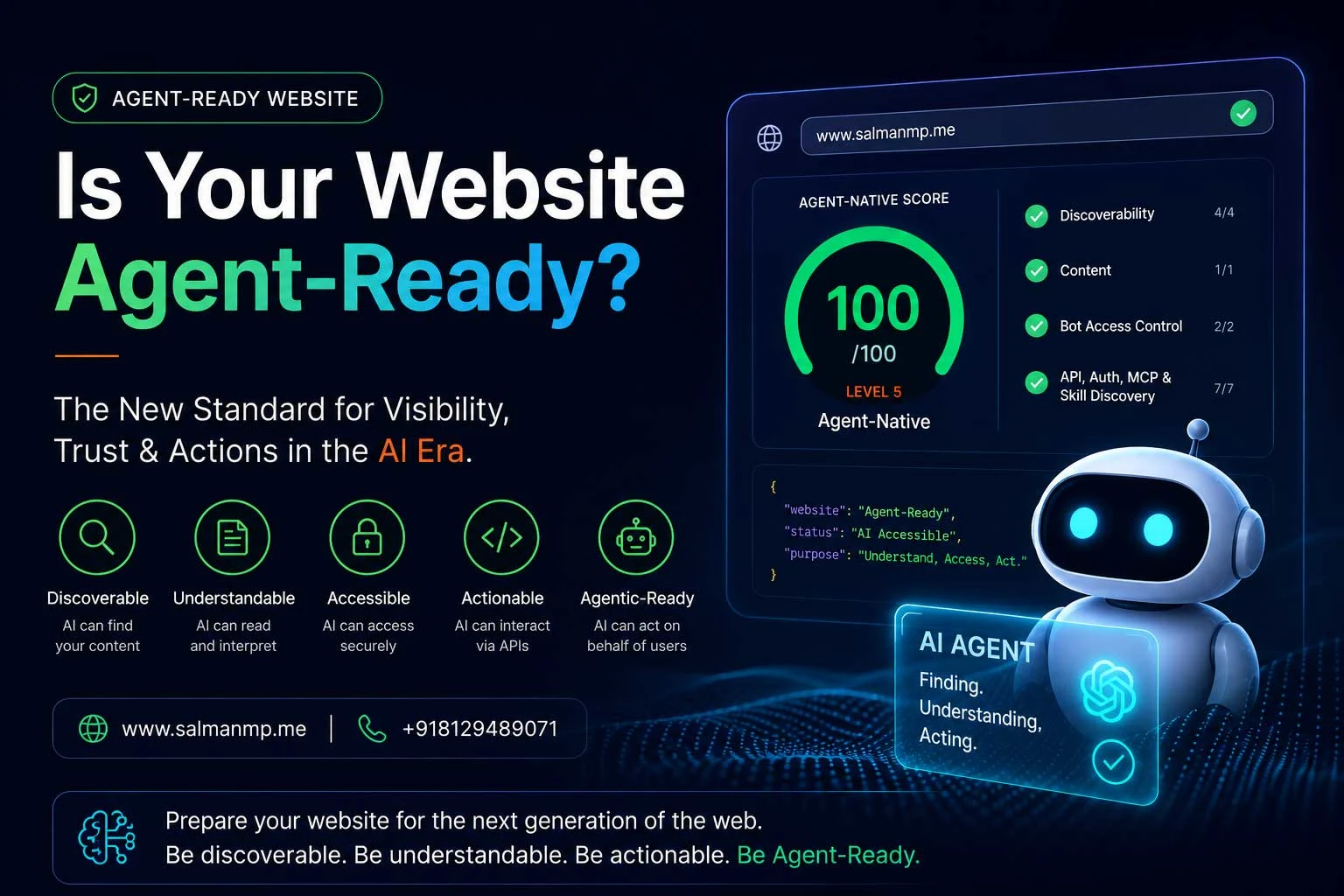
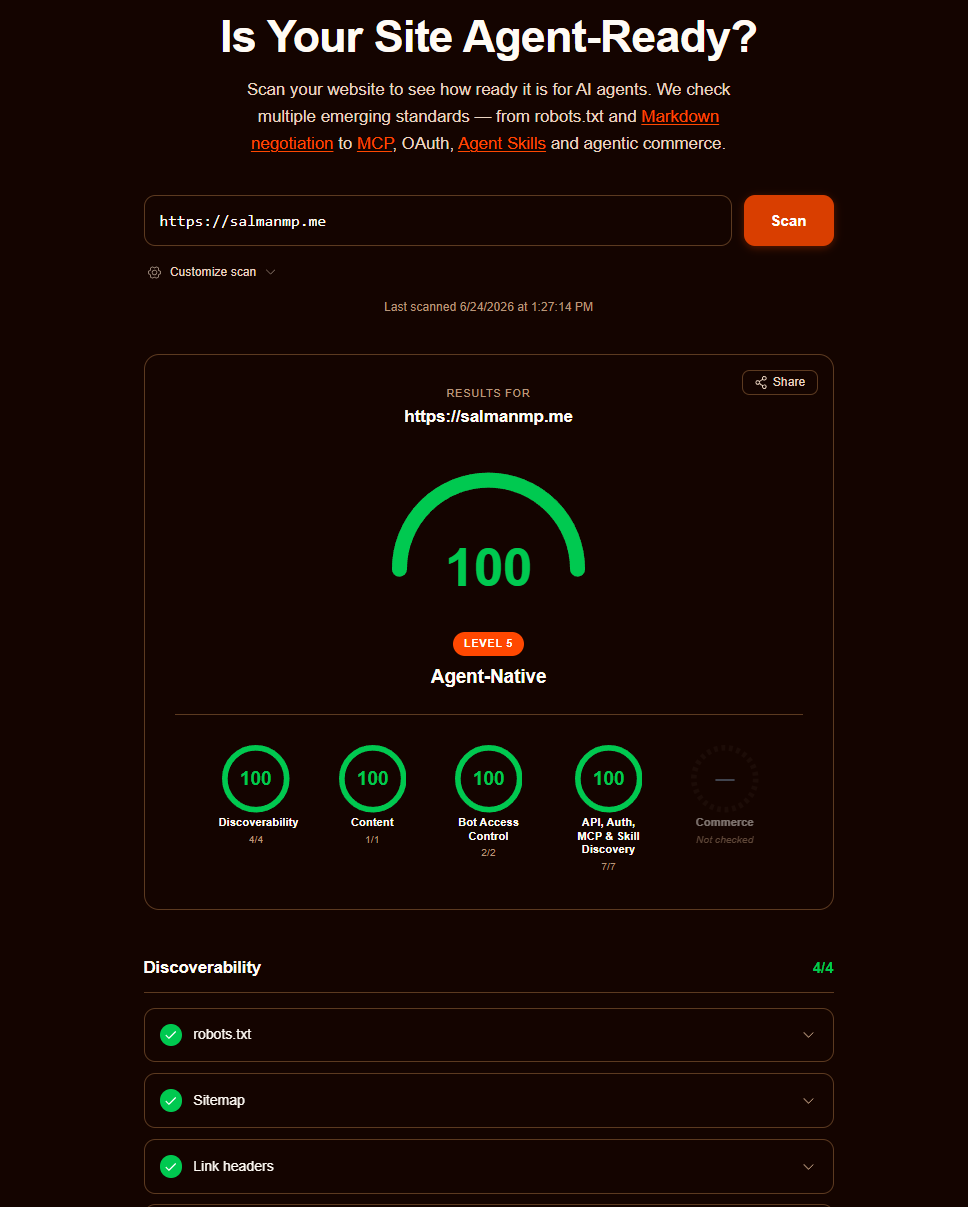
Recently, an assessment of salmanmp.me achieved a perfect 100/100 Agent-Native Score (Level 5), demonstrating full readiness for AI agents across discoverability, content accessibility, bot access control, API readiness, authentication support, and skill discovery.
The result highlights an important reality:
Websites optimized only for humans may soon become invisible to AI agents.
What Is an Agent-Ready Website?
An Agent-Ready website is designed not only for human visitors but also for AI systems that can:
- Discover your content
- Understand your information
- Interact with your services
- Access APIs securely
- Execute tasks on behalf of users
Think of it as the evolution of SEO.
Traditional SEO helps Google understand your website.
Agent Readiness helps AI assistants understand, access, and act upon your website.
Why Is Agent Readiness Important?
1. The Internet Is Moving from Search to Actions
Traditionally, users followed this journey:
Search → Visit Website → Read Information → Take Action
The emerging workflow is:
Ask AI → AI Finds Best Option → AI Performs Action
For example, instead of searching:
Best freelance web designer in Kerala
Users may simply ask:
Find me a web designer with SEO expertise and contact them.
The AI agent will evaluate websites and recommend those it can easily understand and interact with.
If your website is not agent-ready, you may never appear in that recommendation.
2. AI Agents Need Structured Information
Humans can interpret messy websites.
AI agents prefer:
- Clear metadata
- Structured content
- Machine-readable information
- Well-defined navigation
- Accessible APIs
An agent-ready website makes it easier for AI systems to:
- Understand services
- Identify contact methods
- Read pricing information
- Retrieve business details
- Recommend your business confidently
3. Future Commerce Will Be Agentic
Soon, customers may instruct AI assistants:
Order my monthly supplies.
Renew my hosting subscription.
Book an appointment with my preferred consultant.
The AI agent will complete these tasks automatically.
Businesses that expose products, services, APIs, and authentication methods properly will gain a significant competitive advantage.
Key Components of an Agent-Ready Website
1. Discoverability
AI systems must first discover your website.
Essential requirements include:
- robots.txt
- XML Sitemap
- Proper Link Headers
- Crawl Accessibility
Without these, AI agents may struggle to locate and understand your content.
2. Content Accessibility
Your content should be:
- Well-structured
- Semantic
- Machine-readable
- Consistently organized
AI systems process information more effectively when pages contain:
- Proper heading hierarchy
- Structured sections
- Clear service descriptions
- FAQ schemas
- Rich metadata
3. Bot Access Control
Not all bots should have unrestricted access.
Agent-ready websites implement:
- Controlled bot permissions
- Security policies
- Authentication layers
- Responsible crawling practices
This ensures security while still enabling legitimate AI agents to access information.
4. API and MCP Readiness
Modern AI agents increasingly interact through APIs and emerging standards such as:
- MCP (Model Context Protocol)
- OAuth Authentication
- Agent Skills Discovery
These technologies allow AI assistants to perform real actions instead of merely reading content.
Examples include:
- Scheduling meetings
- Creating support tickets
- Fetching live data
- Completing transactions
5. Agent Skill Discovery
AI systems need to understand:
- What your business does
- What actions are available
- Which services can be invoked
Future-ready websites expose these capabilities in a standardized format so agents can discover and utilize them automatically.
Why Businesses Should Start Today
Many businesses delayed SEO adoption and later struggled to compete.
The same pattern is emerging with AI readiness.
Early adopters will gain advantages in:
Better Visibility
AI assistants are more likely to recommend businesses they can understand.
Higher Trust
Structured and accessible information improves AI confidence.
Increased Conversions
AI-driven recommendations can generate highly qualified leads.
Future-Proof Infrastructure
Your website becomes prepared for the next generation of digital interactions.
What Does a Perfect Agent-Ready Score Mean?
Achieving a 100/100 Agent-Native Score indicates:
- Strong discoverability
- Accessible content structure
- Proper bot management
- API and authentication readiness
- Support for emerging AI-agent standards
It demonstrates that a website is prepared for both current AI systems and the future agentic web.
Agent Readiness vs Traditional SEO
| Traditional SEO | Agent Readiness |
|---|---|
| Optimized for search engines | Optimized for AI agents |
| Focuses on rankings | Focuses on understanding and actions |
| Keywords and backlinks | Structured data and machine-readable content |
| User visits website manually | AI can interact on behalf of users |
| Search results drive traffic | AI recommendations drive engagement |
The future web will require both.
SEO helps users discover you.
Agent Readiness helps AI agents recommend and interact with you.
The Next Evolution of the Web
The web has evolved through multiple phases:
Web 1.0
Static websites providing information.
Web 2.0
Interactive websites and social platforms.
Mobile-First Era
Responsive websites optimized for smartphones.
AI-First Era
Websites optimized for AI understanding and automation.
We are now entering the next phase:
The Agentic Web
In this environment, AI agents become the bridge between users and businesses.
Organizations that prepare today will gain visibility, trust, and competitive advantages tomorrow.
Conclusion
The future of the internet is not just about websites that humans can browse.
It is about websites that AI agents can understand, trust, and interact with.
Just as mobile optimization became essential in the smartphone era and SEO became critical in the search era, Agent Readiness is becoming essential in the AI era.
Businesses that prepare now will be easier to discover, recommend, and engage with as AI agents increasingly become the primary interface between users and the web.
The question is no longer:
Is my website mobile-friendly?
Or even:
Is my website SEO-friendly?
The new question is:
Is my website Agent-Ready?
The businesses that answer "yes" today will be best positioned for tomorrow's AI-driven internet.