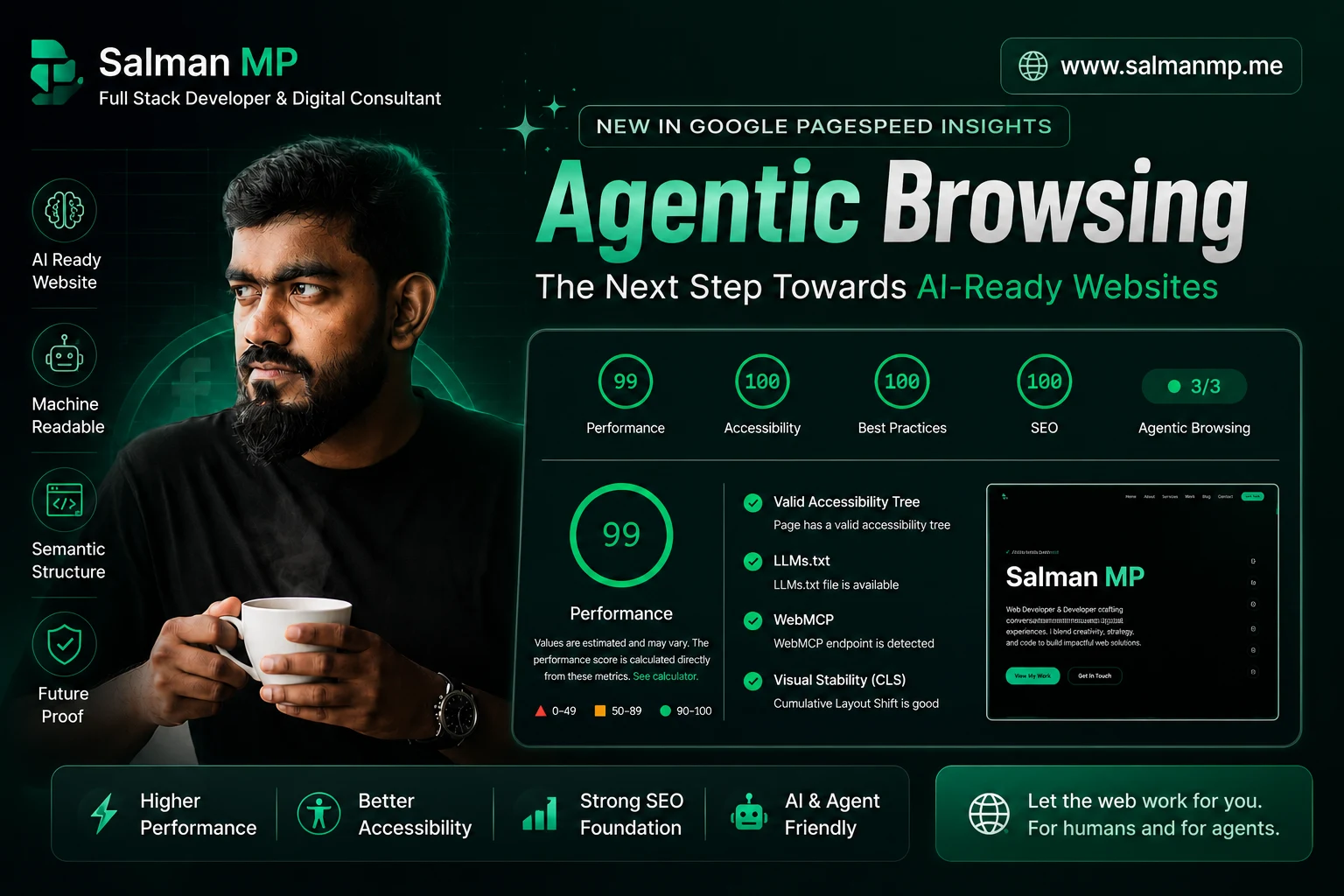
Agentic Browsing Has Arrived in Google PageSpeed Insights 🚀
Visual Overview
Agentic Browsing Has Arrived in Google PageSpeed Insights 🚀
For years, website optimization focused on Performance, Accessibility, Best Practices, and SEO.
Now, Google Lighthouse has introduced an experimental metric that could shape the future of the web:
Agentic Browsing
As AI-powered assistants such as ChatGPT, Gemini, Claude, and other autonomous agents increasingly browse websites on behalf of users, Google is beginning to evaluate how well websites can be understood and interacted with by machines.
This new category measures whether your website is prepared for the next generation of AI-driven browsing experiences.
What is Agentic Browsing?
Agentic Browsing is an experimental Lighthouse audit that evaluates how effectively AI agents can:
- Read your content
- Understand page structure
- Navigate your website
- Interact with website elements
- Access machine-readable information
The goal is simple:
Build websites that are optimized not only for humans and search engines, but also for AI agents.
Key Factors Evaluated
1️⃣ Valid Accessibility Tree
AI systems rely heavily on semantic HTML and accessibility data.
A properly structured DOM helps agents accurately understand:
- Headings
- Navigation
- Content hierarchy
- Interactive elements
Poor semantic structure can make pages difficult for both AI and assistive technologies.
2️⃣ LLMs.txt Support
Lighthouse checks whether your domain provides an llms.txt file.
This file acts as a machine-readable guide that tells AI systems:
- What content exists
- How it can be used
- Crawling instructions
- Important resources
Think of it as a future-friendly companion to robots.txt.
3️⃣ WebMCP Compatibility
WebMCP (Machine Control Protocol) enables websites to expose structured interactions for AI agents.
This allows autonomous systems to perform tasks more reliably rather than guessing how a page works.
Examples include:
- Form interactions
- Data retrieval
- Structured navigation
- Agent-based workflows
4️⃣ Visual Stability (CLS)
AI agents need predictable interfaces.
If elements move unexpectedly while loading, agents may:
- Click the wrong button
- Misread content
- Fail interactions
Lighthouse therefore checks your site's Cumulative Layout Shift (CLS) score to ensure visual stability.
Why This Matters
The way people discover information is changing.
Instead of manually browsing websites, users increasingly ask AI assistants to:
- Compare products
- Find information
- Summarize content
- Complete tasks
Websites that are optimized for AI agents may gain advantages in:
✅ Discoverability
✅ Accessibility
✅ Future AI integrations
✅ Automated interactions
✅ User experience
How to Check Your Score
- Visit Google PageSpeed Insights.
- Enter your website URL.
- Run the audit.
- Review the new Agentic Browsing section.
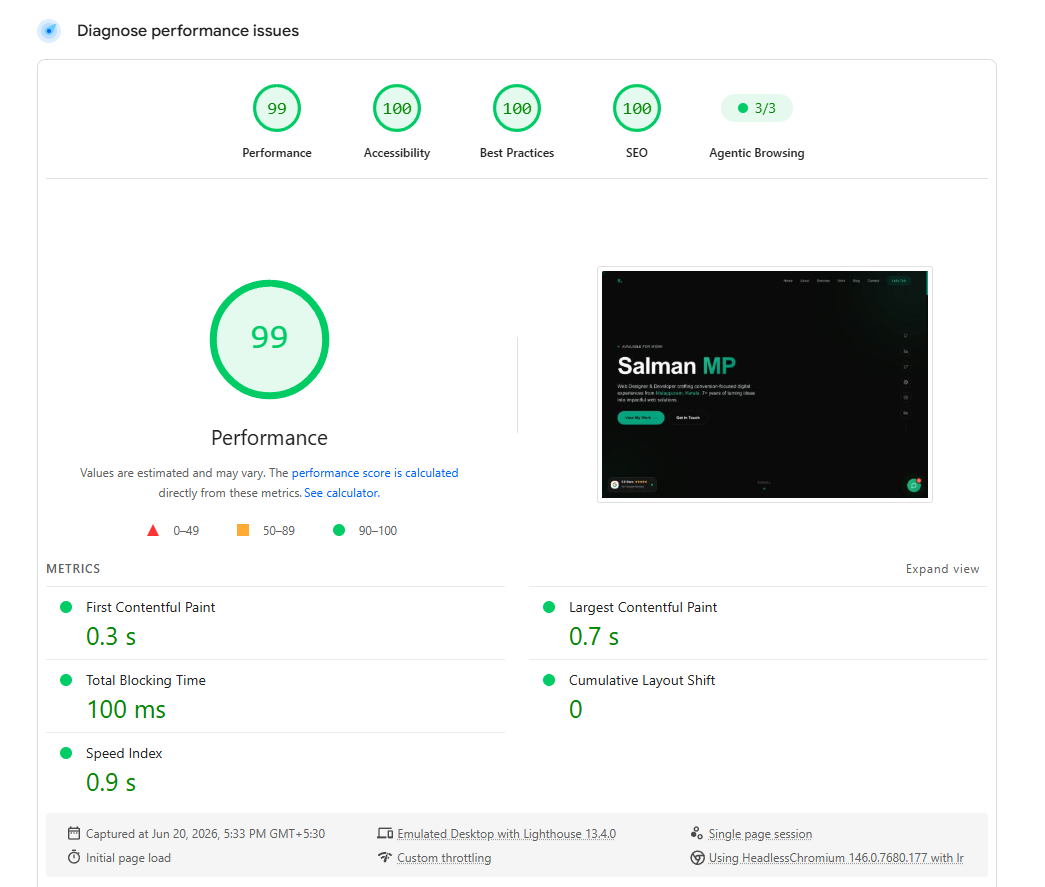
You'll receive pass/fail indicators alongside your existing Lighthouse scores.
My Results
I'm pleased to see my personal website achieved:
- Performance: 99
- Accessibility: 100
- Best Practices: 100
- SEO: 100
- Agentic Browsing: 3/3
The future web is no longer just human-first.
It's becoming human + AI friendly.
See the report here: https://pagespeed.web.dev/analysis/https-salmanmp-me/d7g11oyuho?form_factor=desktop
Final Thoughts
Agentic Browsing may still be experimental, but it signals where the web is heading.
The websites that embrace semantic structure, machine-readable standards, and AI-friendly interactions today will be better prepared for tomorrow's internet.
Have you checked your Agentic Browsing score yet?
🔗 Website: https://www.salmanmp.me
#AgenticBrowsing #GoogleLighthouse #PageSpeedInsights #AI #WebDevelopment #SEO #Accessibility #ChatGPT #Gemini #Claude #FutureOfWeb